 JUVENIS Vouchers
 JUVENIS Vouchers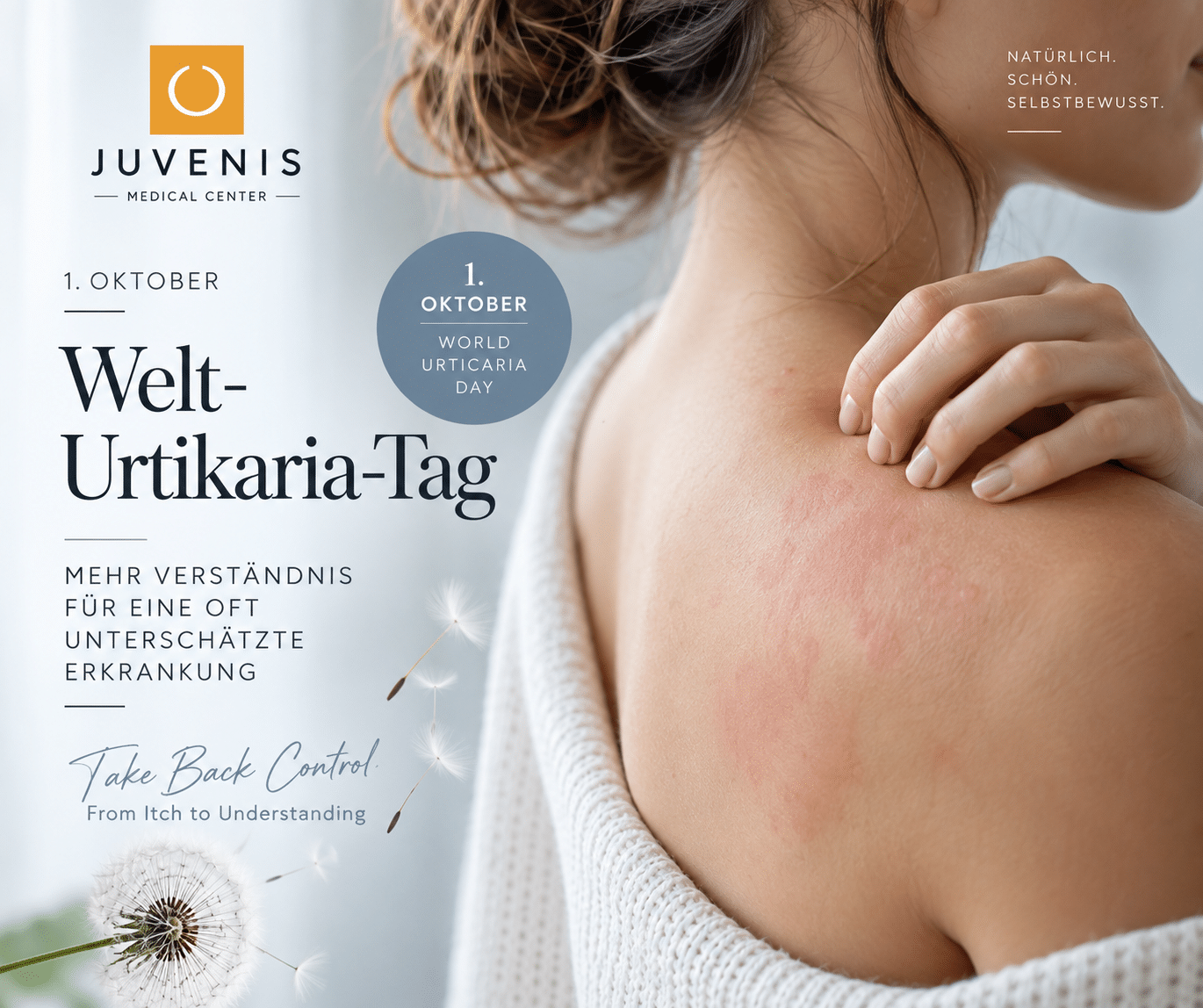
Red wheals, suddenly occurring intense itching, and swellings that seemingly appear without warning and then disappear: urticaria, also called hives, can be a considerable burden for those affected.
On 1 October 2026, Urticaria Day (Urticaria Day/UDAY) will take place worldwide. The aim of the day of action is to raise awareness of the condition, inform about symptoms and treatment options, and put the situation of people with urticaria more in the spotlight. The international motto for 2026 is 'Take Back Control – From Itch to Understanding' — loosely translated: regain control — from itch to understanding. Urticaria affects more than just the skin. Unpredictable flares, persistent itching, and swelling can significantly impair sleep, daily life, and well-being.
At JUVENIS in Vienna, patients with urticaria receive dermatological examinations and individualized treatment.
What is Urticaria?
Urticaria is a skin condition that typically manifests as suddenly appearing wheals and intense itching. The skin changes often resemble contact with stinging nettles — hence the German name 'Nesselsucht'.
Typical symptoms are:
- suddenly appearing wheals
- intense itching
- Redness
- Burning or a feeling of tightness
- Swelling
- sometimes so-called angioedema
A characteristic feature is that individual wheals can disappear again within a relatively short time while new ones form elsewhere on the body.
What is angioedema?
In addition to the classic wheals, so-called angioedema can occur in urticaria. These are swellings in the deeper layers of the skin. They can occur, for example, on:
- Lips
- Eyelids
- Face
- Hands or feet
to occur.
While wheals usually itch intensely, angioedema may be noticed more by a feeling of tightness or by pain.
Acute or chronic urticaria – what's the difference?
In general, a distinction is made between acute and chronic urticaria.
Acute urticaria
If the symptoms persist for less than six weeks, it is referred to as acute urticaria. Possible triggers can include infections or medications. The symptoms often disappear again after some time.
Chronic urticaria
If wheals, itching, or angioedema recur over a period of more than six weeks, this is considered chronic urticaria. Different forms are distinguished. In chronic spontaneous urticaria, symptoms occur without a clearly predictable external trigger. There are also forms in which certain stimuli can provoke the symptoms.
What can trigger urticaria?
Finding the trigger is not always easy. Depending on the form, the following factors may play a role:
infections
- certain medications
- Cold
- Heat
- Pressure or friction
- UV radiation
- physical exertion
- stress
However, with chronic spontaneous urticaria it is not always possible to identify a single specific trigger.
Is urticaria an allergy?
Not every case of urticaria is automatically a classic allergy. Mast cells, which are part of the immune system, play a central role. When they are activated, they release, among other things, histamine. Histamine causes blood vessels to dilate and fluid to leak into the tissues. This leads to the typical wheals (hives), swelling, and the often very severe itching. Therefore, during evaluation it is important not to assume an allergy automatically, but to examine the individual's medical history carefully.
Urticaria is not contagious
An important misconception: urticaria is not contagious. The visible skin changes can sometimes be very pronounced, but they do not pose a danger to other people. That's precisely why education is important. People affected should not be stigmatized because of visible wheals or swelling.
Why can chronic urticaria be so burdensome?
Anyone who regards urticaria only as a temporary rash often underestimates the impact of the disease. In particular, chronic urticaria can significantly affect everyday life.
Intense itching can:
- affect sleep
- impair concentration
- affect work and leisure
- be physically very burdensome
Added to this is the unpredictability of flare-ups. Those affected often do not know when or where on the body the next wheals or swellings will appear. This is exactly what the motto of World Urticaria Day 2026 draws attention to: the disease should not be judged solely by its visible skin changes.
Documenting urticaria: Photos can help during doctor visits
One characteristic of urticaria is that skin changes can appear quickly and disappear just as quickly. By the time of the doctor's appointment, the wheals may therefore no longer be visible.
At JUVENIS, patients are therefore advised to document any flare-ups that occur.
Helpful measures include:
- Photos of skin changes
- Time of onset
- Duration of symptoms
- Possible triggers
- Associated symptoms
- Medications used
This information can facilitate dermatological evaluation.
How is urticaria treated?
Treatment depends on the form, severity, and duration of the condition. It begins with a detailed dermatological history and examination. The aim is to identify and, as far as possible, avoid potential triggers. Antihistamines play an important role in drug treatment. They reduce the effect of the messenger substance histamine and can thereby alleviate wheals and itching. For chronic urticaria that cannot be sufficiently controlled with these, other modern therapy options are now available. Depending on the medical assessment, these may also include biologics. Which therapy is suitable must be decided individually and adapted to the course of the disease.
What can people affected do themselves?
In addition to appropriate medical treatment, it can be helpful to avoid known personal triggers as much as possible. Depending on the individual situation, the following measures may also help:
- Avoid irritating the skin as much as possible
- Avoid known triggers
- Use suitable gentle skin care
- Reduce stress
- Document flare-ups
- Take prescribed medications regularly and as directed by your doctor
It's important not to unilaterally eliminate more and more presumed triggers from your diet or everyday life. A targeted medical evaluation is preferable to unnecessary restrictions.
When should urticaria be evaluated by a doctor?
A dermatological evaluation is particularly advisable if:
- hives recur
- symptoms persist
- severe itching interferes with daily activities or sleep
- angioedema occurs
- the cause is unclear
- previous treatments are not sufficiently effective
In contrast, sudden swelling of the mouth or throat, shortness of breath, circulatory problems or other signs of a severe allergic reaction require immediate emergency medical attention.
Urticaria treatment at JUVENIS in Vienna
At JUVENIS in Vienna, the treatment of urticaria begins with a comprehensive dermatological examination and medical history. Symptoms, possible triggers and the previous course of the disease are taken into account. An individual treatment plan is then created. In addition to searching for potential triggers, modern pharmacological therapy options are available. For patients with chronic urticaria whose symptoms cannot be adequately controlled with standard therapy, further treatments can also be considered. The goal is not only short-term relief of itching but as good and long-term control of the disease as possible.
World Urticaria Day 2026: Greater understanding for an often underestimated condition
World Urticaria Day on 1 October 2026 serves as a reminder that visible wheals often indicate a condition that can significantly impair daily life. This year's motto 'Take Back Control – From Itch to Understanding' therefore puts the experiences of those affected at the center. Anyone who repeatedly suffers from unexplained wheals, severe itching or swelling should not simply accept the symptoms. A dermatological evaluation can help determine the form of urticaria and find an appropriate treatment.
Modern therapies can today help many affected people to control symptoms much better – and thereby restore a measure of quality of life.
For more information about urticaria treatment at JUVENIS, please visit our website here: Treatment of urticaria (hives) in Vienna
JUVENIS in Vienna offers services related to Health & preventive care, Radiance & posture as well as Outer beauty that make you outwardly radiant and enhance your well-being.
Contact us, we will be happy to inform you!