 JUVENIS Vouchers

 JUVENIS Vouchers
Brown spots on the face, on the hands, or on the décolleté are particularly common with increasing age. Often these are harmless age spots caused by years of sun exposure. But not every brownish skin change is automatically harmless.
How can you tell the difference between age spots and skin cancer? Which changes should be examined by a doctor, and when is laser treatment advisable?
At JUVENIS in Vienna, noticeable pigment changes can be assessed dermatologically. Because before bothersome skin spots are removed for aesthetic reasons, it should be ensured that no suspicious skin lesion is present.
What are age spots?
Age spots are medically referred to as lentigines solares. They are benign pigment changes that arise mainly from long-term UV exposure. They occur preferentially on parts of the body that are frequently exposed to the sun:
- Face and forehead
- Back of the hand
- Décolleté
- Shoulders
- forearms
Age spots arise from an increased accumulation of the skin pigment melanin in certain skin areas. Typically they are flat, light brown to dark brown, and clearly demarcated from the surrounding skin. They usually cause neither pain nor itching and do not require medical treatment. However, other skin changes can look similar. A reliable distinction is therefore not always possible with the naked eye.
What does skin cancer look like?
Skin cancer can present in very different ways. It is particularly important to distinguish between melanoma ("black" skin cancer) and non-melanoma ("white" skin cancer).
Black skin cancer – malignant melanoma
Malignant melanoma is a particularly dangerous form of skin cancer because it can metastasize early. It can develop from an existing mole or appear on previously unremarkable skin.
Possible warning signs are:
- Irregular shape
- Different shades within a spot
- Blurred or ragged border
- Change in size, color, or shape
- New noticeable pigment changes
Not every melanoma is darkly pigmented. Some melanomas can also appear pink, reddish, or almost skin-colored. Important: A melanoma can resemble a harmless age spot.
Non-melanoma skin cancer – basal cell carcinoma and squamous cell carcinoma
Non-melanoma skin cancer can also develop on sun-exposed areas of the skin. A basal cell carcinoma can, for example, present as a shiny nodule, a reddish spot, or a poorly healing area of skin. Some forms are pigmented and can therefore resemble a brown skin spot. Squamous cell carcinomas often appear as keratinized, scaly, or nodular skin changes. For this reason, skin areas that repeatedly bleed, crust over, or do not heal should also be examined.
Age spots or skin cancer: the main differences
| Feature | Typical age spot | Possible skin cancer |
|---|---|---|
| Shape | Mostly round or oval | Sometimes asymmetrical or irregular |
| Color | Often fairly uniformly brown | Sometimes multiple shades |
| Border | Often well-defined | Partly indistinct or frayed |
| Surface | Mostly flat and smooth | Can be flat, raised, scaly, or nodular |
| Change | Often slowly over years | May change noticeably |
| Symptoms | Usually none | Sometimes itching, bleeding, or crusting |
Important: These characteristics are intended only as a guide. Skin cancer can also appear evenly colored, symmetrical, and unremarkable. Conversely, benign pigmented spots may appear irregular. A reliable diagnosis cannot be made from this table.
The ABCDE rule: How to recognize suspicious skin changes
The ABCDE rule helps to recognize possible warning signs of a malignant melanoma.
A – Asymmetry
A pigmented spot is irregularly shaped and cannot be divided into two similar halves.
B – Border
The borders are irregular, jagged, frayed, or blurred.
C – Color
Different shades appear within a spot, for example various shades of brown, black, red, or gray.
D – Diameter
Pigmented spots with a diameter of more than about six millimeters should be monitored particularly closely. However, smaller changes can also be malignant.
E – Evolution
Change over time is particularly important. If a spot grows, changes color, bleeds, or suddenly looks different, it should be examined by a dermatologist.
The development of a skin change is one of the most important warning signs.
The Ugly Duckling sign: when a spot looks different
In addition to the ABCDE rule, there is another helpful clue: the so-called ugly-duckling sign. Many people have multiple moles that resemble each other in shape and color. A skin lesion that differs markedly from the others should therefore be given special attention. A newly appeared, unusual spot may also warrant a dermatological examination.
Can age spots turn into skin cancer?
True age spots (solar lentigines) are benign and usually do not develop into skin cancer. However, age spots preferentially appear on sun-exposed areas of the skin. Long-term UV exposure is also an important risk factor for various types of skin cancer. Age spots can therefore be a visible sign of sun exposure accumulated over years. Another important point: not every change that looks like an age spot is actually a solar lentigo. In particular, the so-called lentigo maligna melanoma can initially resemble an irregular age spot and often occurs on chronically sun-damaged skin. For this reason, a specialist examination is especially important for suspicious pigmentary changes.
How does the dermatologist examine suspicious pigmented lesions?
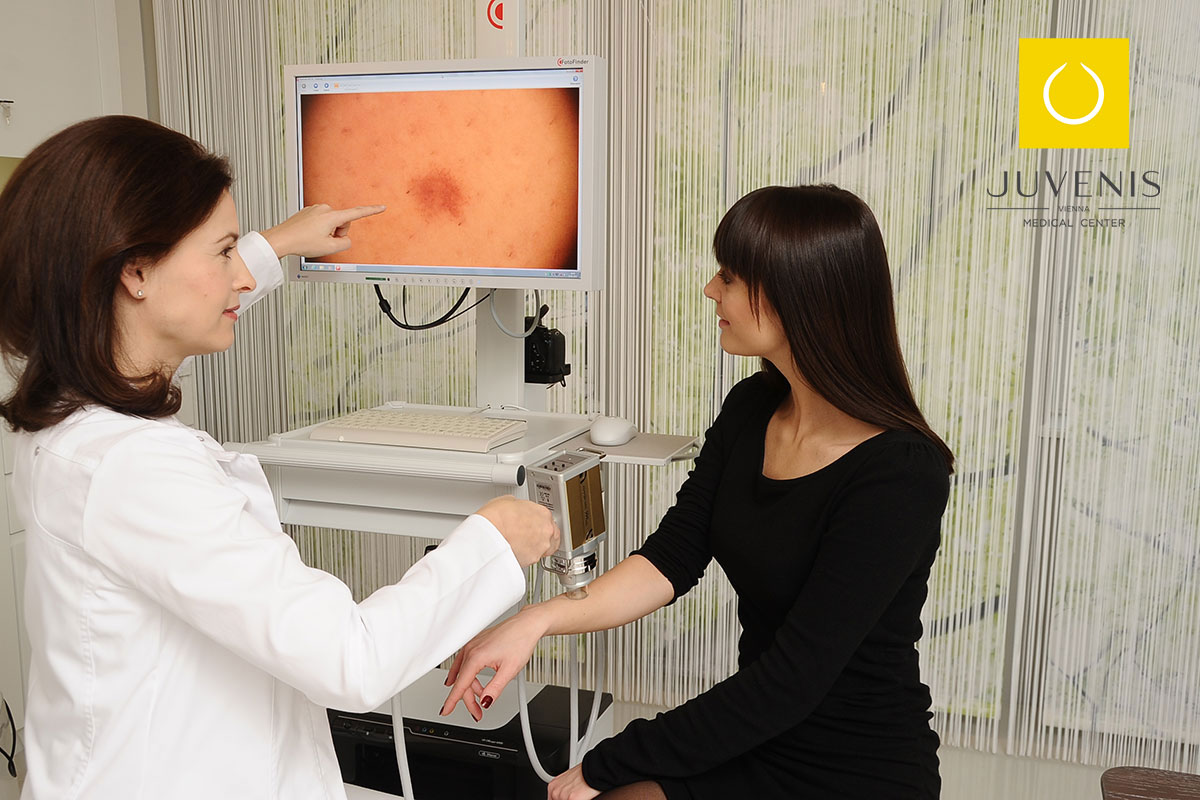
In a dermatological examination, pigmented lesions are initially assessed with regard to their shape, color, border and development. An important diagnostic method is dermatoscopy. For this, the dermatologist uses a special magnifying device that allows structures within the skin to be seen more clearly. Dermatoscopy enables a more detailed assessment than inspection with the naked eye. Depending on the findings, it can be decided whether:
- the skin lesion is unremarkable,
- a follow-up check is advisable,
- further diagnostic measures are necessary, or
- a tissue sample or surgical removal for histological examination is required.
A suspicious skin lesion should not be treated with laser purely for cosmetic reasons, as important diagnostic information can be lost.
Removing age spots: What treatment options are available?
If dermatological confirmation shows that it is a benign pigmentary change, a cosmetic treatment may be considered. At JUVENIS in Vienna, various dermatological and aesthetic treatment options are available. Which method is suitable depends, among other things, on the type, depth and extent of the pigmentation as well as the individual skin type.
IPL and light-based procedures
Intense pulsed light (IPL) can also be used for certain superficial pigmentations. The light energy is selectively absorbed by pigmented structures. These procedures can help reduce sun-induced pigment irregularities and make the skin appear more even. However, not every pigment disorder is suitable for IPL treatment.
Further information about IPL treatment for age spots can be found on our website here: Behandlung von Pigmentflecken, Altersflecken, Melasma, und Lentigines solares
Medical peels
For selected superficial pigmentary changes, medical peels can also be used. Special active ingredients are applied to support the renewal of superficial skin layers. Which peeling method is appropriate depends on the individual skin condition.
Further information about our peels can be found on our website here:
Why autumn and winter are often ideal for pigmentation treatments
After certain laser and peeling treatments, the skin is temporarily more sensitive to UV radiation. Because sun exposure is usually lower in autumn and winter, necessary sun protection measures can often be followed more easily. Therefore, the cooler months are particularly well suited for many pigment treatments. However, it is important that the skin is still consistently protected from UV radiation during this season.
Can age spots be prevented?
Since UV radiation plays a major role in the development of age spots, consistent sun protection is the most important preventive measure.
These include:
- Daily sun protection with a sufficiently high SPF
- Avoiding intense midday sun
- Protective clothing and head coverings
- Avoiding tanning beds
- Regular monitoring of your skin
Appropriate skincare can also help support the skin barrier and counteract light-induced skin changes.
Pigmented spots and skin cancer screening at JUVENIS in Vienna
At JUVENIS in Vienna, careful dermatological assessment of pigmentary changes is central. After all, not every brown spot is automatically a harmless age spot. During a dermatological examination, suspicious moles and pigment changes can be evaluated and, if necessary, further investigated. Only once a skin change has been classified as benign should aesthetic removal be considered. For suitable pigment spots, depending on the findings, modern laser- and light-based procedures as well as medical peels may be options.
Make an appointment at JUVENIS in Vienna if you notice new or changed pigmented spots or would like information about treatment options for age spots.